


Titan Haus™ Pure Titanium Water Bottle
Titan Haus™ Pure Titanium Water Bottle
Type
Out of stock
Couldn't load pickup availability
0 have this item in their cart.

FREE Shipping
& Easy Returns

30-Day Money-
Back Guarantee

Top Rated
Customer Support
Stop Filtering Into Plastic.
You filter your water. Then you pour it into plastic. That’s where the recontamination begins. Titan Haus Titanium Water Bottles remove plastic from the final mile of hydration - so the water you purified stays purified. Available in:
• 350 ml - Compact Carry
• 500 ml - Standard Daily
Ultra-light. Ultra-clean. Built for life.
-
Even high-quality filtered water can become contaminated again when stored in plastic. Recent analytical studies using advanced spectroscopy have detected: ~240,000 to 400,000 plastic particles in a single liter of bottled water Approximately 90% of those particles were nanoplastics (smaller than 1 micron). Nanoplastics are small enough to:
• Cross biological membranes
• Circulate in the bloodstream
• Accumulate in organs in experimental models
Plastic bottles themselves - along with caps, threads, and handling friction - are a primary source of particle shedding.
Filtering water and then storing it in plastic reintroduces a synthetic contact surface at the final step.
Hydration shouldn’t undo your filtration.
-
✔ Certified 99%+ Pure Titanium
✔ Zero Plastic Contact Interior
✔ No polymer linings.
✔ No BPA. No phthalates.
✔ No interior coatings.
✔ 2× Lighter Than Steel
✔ Biocompatible & Non-Reactive.
✔ No Metallic Aftertaste.
✔ Corrosion Resistant for Life.
✔ Minimal, Portable Design.
✔ Built for Lifetime Use.


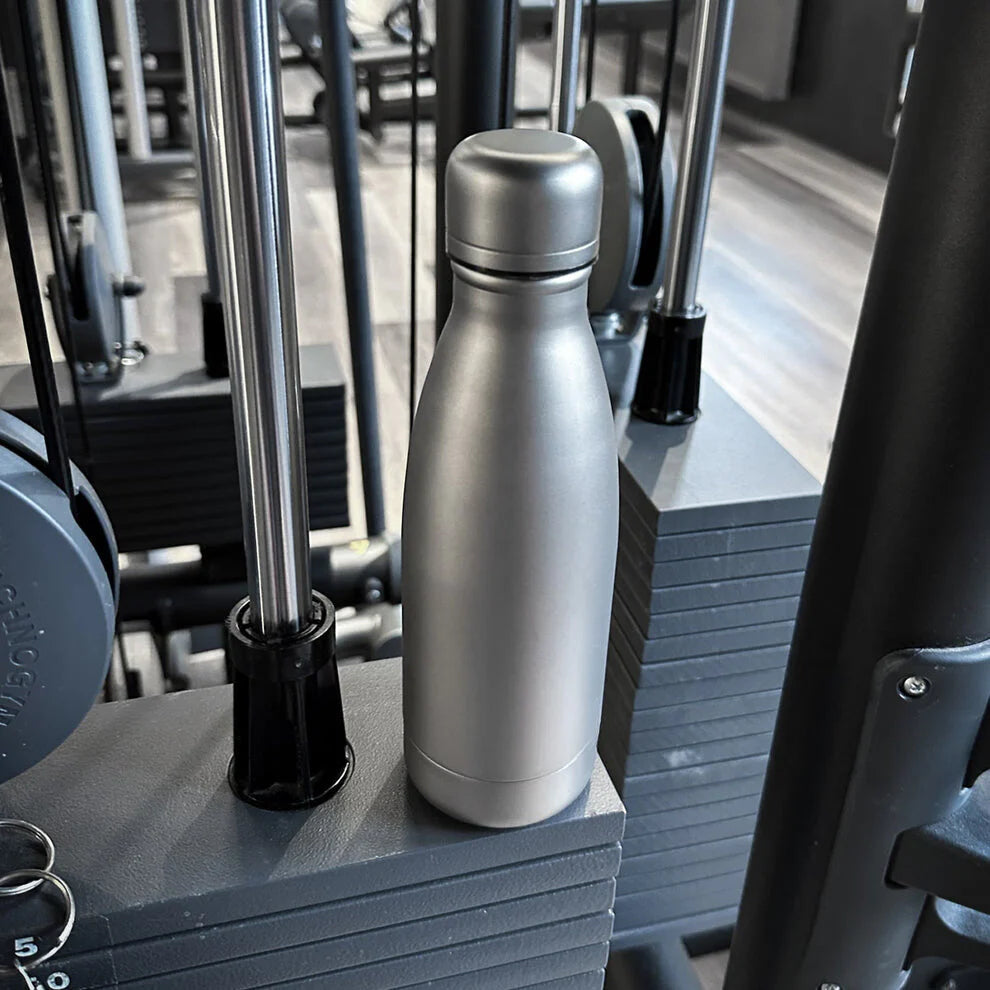
Why Titanium Water Bottles Are Different
The Titan Haus Difference
Removes Plastic From the Equation
No polymer walls. No endocrine disruptors. No particle shedding.
Titanium is a single-element metal with a naturally forming oxide layer that makes it:
• Non-reactive
• Non-leaching
• Structurally stable
• Free from BPA, BPS, phthalates, and polymer breakdown
It does not degrade into particles with repeated use.
One permanent intervention in a daily exposure pathway.
Micro and Nanoplastics form plastic Bottles
Recent analytical studies using advanced spectroscopy have detected:
~240,000 to 400,000 plastic particles in a single liter of bottled water
Approximately 90% of those particles were nanoplastics (smaller than 1 micron).
Nanoplastics are small enough to:
• Cross biological membranes
• Circulate in the bloodstream
• Accumulate in organs in experimental models
What That Means Over Time
If someone consumes:
1 liter per day from plastic bottles
That equates to approximately:
• 7.2–12 million plastic particles per month
• 86–146 million particles per year
At 2 liters per day, those figures double.
Why Plastic Ingestion Matters
Microplastics and nanoplastics have now been detected in:
• Human blood
• Lung tissue
• Placental tissue
• Testicular tissue
• Brain tissue and more
Emerging research is exploding, showing links to:
• Hormone disruption
• Chronic inflammation
• Oxidative stress
• Heart disease
• Dementia
• and more
The science is evolving - and exposure is no longer hypothetical.
The final container matters.
The Simple Intervention
You can’t eliminate plastic everywhere.
But hydration is a daily, high-volume exposure pathway.
Removing plastic from the last step - storage and transport - is one of the simplest structural upgrades you can make.
Titanium replaces the polymer interface with a stable, inert metal surface.
No interior linings.
No coatings.
No polymer walls to shed.
Titanium vs Stainless Steel
Most “metal” bottles are stainless steel.
Titanium operates at a different level.
1. 45% Lighter Than Steel
Titanium’s strength-to-weight ratio is exceptional.
It is roughly 45% lighter than steel while maintaining comparable strength.
Why this matters:
• Less container weight
• Easier daily carry
• Ideal for hiking, travel, commuting
• Carry more water, not more metal
Our titanium bottles are approximately 2× lighter than equivalent steel bottles of similar durability.
Every gram counts.
2. Biocompatibility & Taste Purity
Titanium is widely used in:
• Orthopedic implants
• Dental implants
• Surgical devices
Because the body does not reject it.
It is considered highly biocompatible and chemically inert.
Zero Metallic Aftertaste
Unlike some lower-grade stainless steels:
• Titanium does not react with acidic liquids
• No metallic taste with lemon water, electrolytes, or coffee
• Water tastes like water
No lining required. No coatings. No interior treatments.
3. Corrosion Resistance
Titanium is:
• Highly resistant to salt
• Highly resistant to acids
• Virtually immune to long-term corrosion
Stainless steel can degrade over many years in harsh conditions. Titanium is structurally stable for life.
4. Thermal Performance
In single-wall form:
• Titanium often feels less harsh to the touch with hot liquids compared to thin steel
• Excellent for minimalist, lightweight carry
For insulation, both steel and titanium rely on vacuum-sealed double-wall technology - but titanium does it at a significantly lower weight.
Two Sizes. Minimal Form.
350 ml - Compact
For light carry, short trips, gym sessions, and minimal bags.
500 ml - Standard
Daily hydration, travel, commuting.
Both are:
• Minimal silhouette
• Sleek matte finish
• Portable profile
• Designed for long-term daily use
Designed for the Last Container You’ll Ever Need
Plastic bottles are temporary.
Steel bottles are heavy.
Titanium is permanent.
When you filter your water, finish the process properly.
Choose the final material carefully.